
“Tell Me About Yourself”: Interview Answers for Bangladeshi Fresh Graduates
Build an honest interview introduction as a fresh graduate using relevant experience, clear examples, and a practical rehearsal exercise.
YOUR READING GOAL
What you will take away
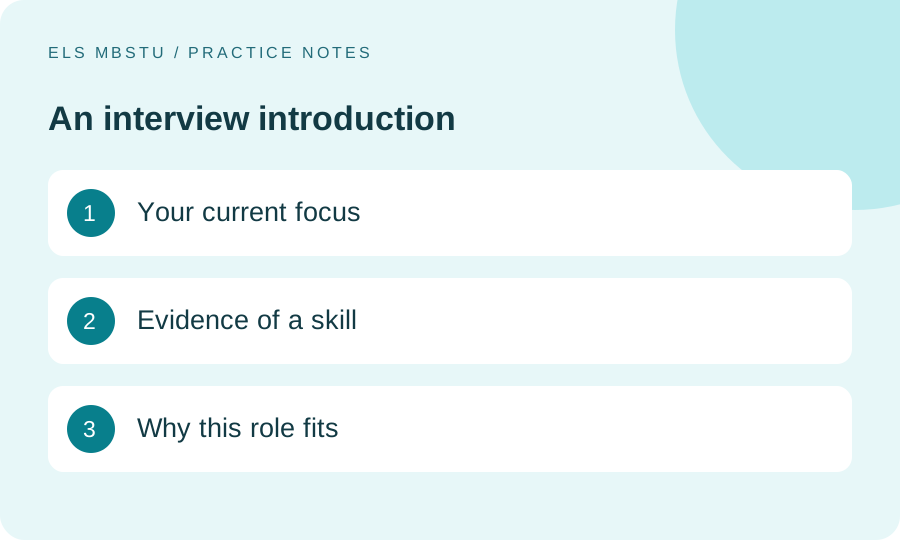
- Practise: your current focus
- Practise: evidence of a skill
- Practise: why this role fits
Imagine that an interviewer begins with “Tell me about yourself.” You prepared for technical questions, but this open invitation feels harder. Should you describe your family, list every course, or repeat your entire CV?
Give a focused introduction: your current position, one or two relevant experiences, and why they connect to the role. The aim is to help the interviewer understand your application and decide what to explore next.
You do not need paid work experience to have something useful to discuss. A genuine academic project, volunteering responsibility, part-time task, or independent piece of work may provide relevant evidence. What matters is explaining your actual contribution clearly.
Read the role before writing the answer
Identify two or three requirements from the job description. For example, a support role might involve answering questions and keeping accurate records. A technical role might emphasise a particular tool, problem-solving process, or project skill.
Choose experience that connects to those requirements. Do not use the same answer unchanged for every role simply because the opening question is the same.
If the advertisement is unclear, keep your claims modest and use the interview to ask about the responsibilities. You should not have to invent an understanding of the organisation to sound interested.
Use a three-part structure
Present: state what you are studying or have recently completed and the area you want to work in.
Evidence: describe a relevant task, what you personally did, and an outcome or lesson you can support.
Connection: explain why that experience makes this role interesting and what you hope to contribute or develop.
This structure is a preparation tool, not a compulsory script. Follow the interviewer's request if they ask for a shorter answer or a particular part of your background.
Example: a communication-focused role
The following is a fictional model, not a real applicant's story:
“I'm a recent graduate interested in customer support. During a university event, I helped manage registration questions and update participant information. I learned to check the details before giving an answer and to explain the next step clearly when someone was confused. I'm interested in this role because it involves those communication tasks, and I would like to develop them in a professional team.”
The answer names an experience and explains its relevance. It does not claim that event volunteering is identical to professional customer support. It shows a starting point for a discussion.
Use this model only if you have comparable experience. If you did not help with registration, choose a different task rather than borrowing the story.
Example: a project-focused role
Here is another invented model:
“I recently completed my degree and have been developing my skills through small software projects. In one group assignment, I worked on the form interface and checked how it behaved when required information was missing. That taught me to think about both the code and the person using it. I'm applying for this role because I want to keep developing those skills while working on real product requirements.”
The example gives the interviewer several useful follow-ups: what the form did, how the applicant tested it, and what problems they encountered. Be ready to explain any tool or task you mention.
Avoid listing technology names that you cannot discuss. A small project you understand is a stronger basis for an honest conversation than a long list of borrowed achievements.
Turn a modest experience into clear evidence
Suppose you prepared slides for a class project. “I have excellent teamwork skills” is an assertion. “I combined our group's sections into one deck and checked that the terminology was consistent” describes what you did.
You can add a truthful result: “The final deck used the same labels throughout.” Do not change that into “I increased team productivity by 80 per cent” without a real measurement and a defensible method.
If you cannot name a measurable result, explain a specific lesson or deliverable. “I learned that we needed to agree on terminology before writing separate sections” is concrete and believable.
Be precise about shared work
Use we for the team's overall project and I for your contribution. For example: “We compared two approaches. I organised the comparison table and checked the labels.”
This distinction matters when several people worked on the same outcome. You can show responsibility without claiming that you completed the entire task alone.
If you received help, you can explain how you used it: “A teammate reviewed the first version, and I revised the layout based on that feedback.” Working with feedback is itself something you can discuss honestly.
Avoid a list of unsupported qualities
Compare these versions:
“I'm hardworking, dynamic, passionate, dedicated, and a perfectionist.”
“In our project, I kept a record of unfinished tasks and checked the final document against the submission requirements.”
The second allows the interviewer to infer relevant habits from an example. It also gives you a clearer answer if they ask, “Can you tell me more?”
There is nothing wrong with naming a strength, but support it. “I enjoy organising information” can lead naturally into a task that shows what you mean.
Keep the language natural
Write an answer you can say aloud. You do not need a ceremonial opening such as “It is my immense privilege to stand before your esteemed presence” unless a particular context genuinely calls for it. A simple “Thank you. I'm …” is enough to begin.
Use words you understand. If you call yourself “proficient” in a skill, be prepared to explain what you can actually do with it. Avoid inflated wording that creates an expectation beyond your experience.
বাংলা সহায়তা: নিজের কাজের উদাহরণ আগে ছোট করে লিখে নিন—কাজটি কী ছিল, আপনি কী করেছেন, কী শিখেছেন। তারপর ইংরেজিতে বলুন। অন্যের পুরো উত্তর মুখস্থ করে নিজের অভিজ্ঞতা হিসেবে ব্যবহার করবেন না।
Rehearse for questions, not recitation
Practise your answer aloud and check its length. A concise initial answer leaves space for follow-up questions; the exact length should fit the interviewer's guidance and the setting.
Ask a friend to choose one claim and question it: “What did you check?” “What was difficult?” “What would you do differently?” If you cannot answer, revise the claim or prepare the missing detail.
Practise a shorter version too. You may need to introduce yourself quickly in a phone call or at the beginning of a group interview. Keep the same truthful facts while reducing the detail.
Exercise: build your own answer
Complete these notes:
- My current study or graduation status:
- One relevant requirement from the role:
- A genuine task connected to that requirement:
- My personal contribution:
- A result or lesson I can explain:
- Why the role interests me:
Turn the notes into a short spoken answer. Remove any sentence that merely repeats your CV without explaining relevance.
Self-check before the interview
Can you support every claim? Have you separated your contribution from the team's work? Does the answer relate to this role? Can you explain the example without memorising a paragraph?
A strong practice answer gives the listener a clear starting picture and invites useful questions. It cannot guarantee selection, because hiring decisions depend on the role and the employer's assessment.
For other settings, use the self-introduction guide. To practise answering follow-up questions in English, choose a relevant prompt from the conversation topic collection.