
How to Introduce Yourself in English: University, Viva, and Interview Examples
Introduce yourself in English for class, a viva, or an interview using natural structures, honest examples, and a short practice exercise.
READ · TRY · CHECK · REPEAT
What you will practise
- Choose details that fit a classroom, viva or interview.
- Repair an unnatural opening without memorising a speech.
- Write an honest introduction and practise a follow-up conversation.
This records completed tasks, not a fluency score. Your writing and progress stay in this browser; they are not synced to an account or submitted to a server.
Imagine a teacher asks you to introduce yourself. You know your name, department, and interests, but you begin searching for a formal speech. By the time you find an opening, you have forgotten what you wanted to say.
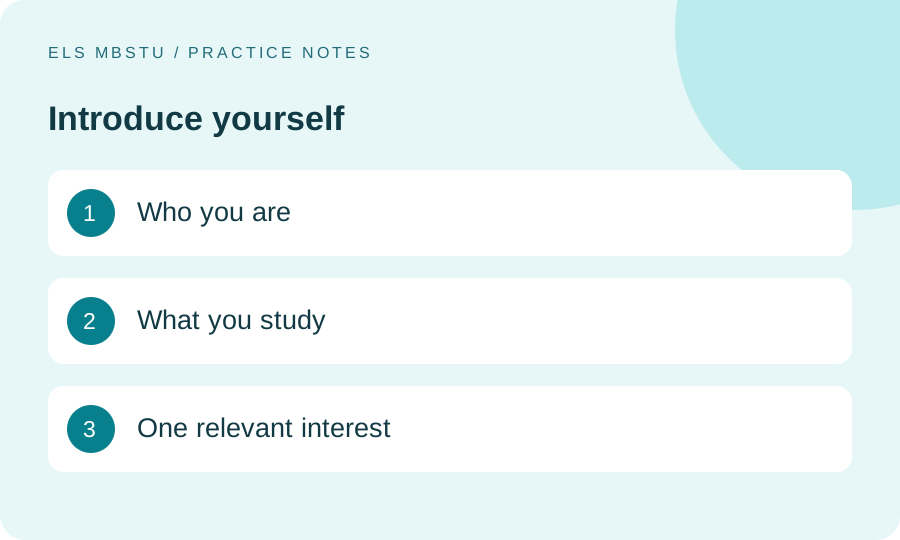
Use a simple structure: who you are, what is relevant here, and one useful detail. Your introduction should give the listener a reason to continue the conversation. It does not need to tell your entire life story.
The examples below are fictional models. Replace their details with your own, and adjust them to the situation rather than memorising them word for word.
Start with the listener's situation
A classmate wants to know how to talk to you. A viva examiner may already have your name and want to understand your academic work. An interviewer wants to hear how your experience connects to a role.
Before writing an introduction, finish this sentence: “After listening, this person should know …”
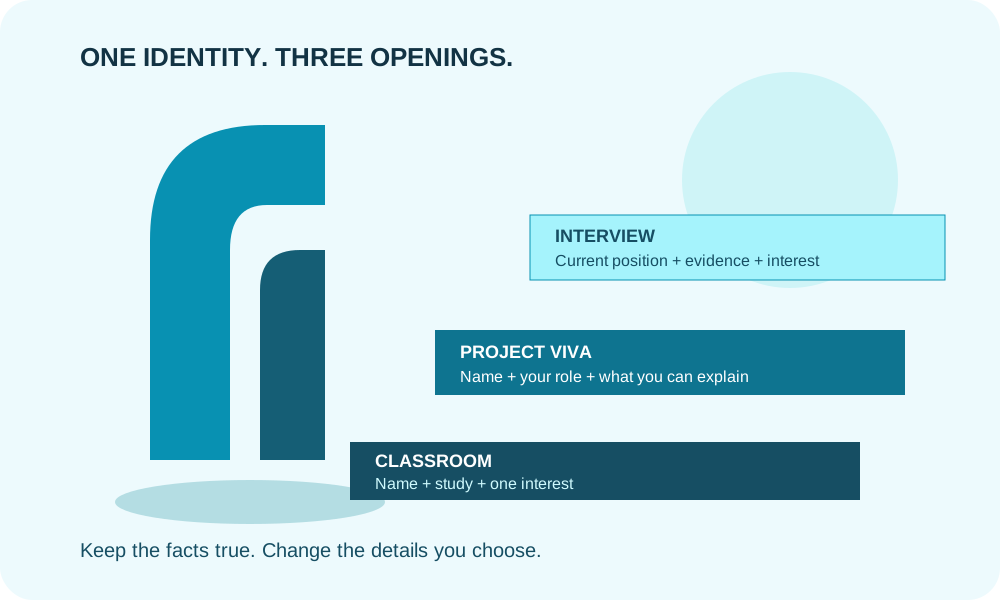
The facts about you stay the same. The listener determines which facts deserve space in this particular introduction.
For a classroom, your answer might be “my name, department, and one interest”. For a project viva, it might be “my role in the project and what I worked on”. For an interview, it might be “the experience that makes my application relevant”.
This choice helps you leave out details that are true but unnecessary. You do not have to include your age, family background, or home address simply because an old model introduction included them.
Build a short classroom introduction
Try this pattern:
“Hello, I'm [name]. I'm a [year] student in [department]. I'm interested in [specific interest], and I'd like to learn more about [goal].”
Here is an invented example:
“Hello, I'm Rafi. I'm a first-year student interested in environmental science. I enjoy learning how small changes can reduce waste. I'd like to become more comfortable discussing my ideas in English.”
The answer provides several possible follow-up questions. A listener can ask about waste, university life, or English practice. “I have many hobbies” gives them less to work with than one specific interest.
If you are not comfortable speaking for that long, use two sentences: “Hi, I'm Rafi. I enjoy reading about the environment.” You can add details when someone asks.
Give a classmate something to ask about
A new classmate asks you to introduce yourself. Which answer gives them a clear starting point for a conversation?
Show a hint
Look for a name and one specific, relevant detail. A longer answer is not automatically better.
Make a viva introduction relevant to your work
Follow the examiner's actual instruction. If they ask only for your name and roll number, give that information. A prepared speech should not prevent you from answering the question you heard.
If they ask you to introduce yourself and your project, connect your identity to the work:
“Good morning. I'm Nadia, and I worked on our group's water-use project. My main responsibility was organising the observations and preparing the comparison table. I can explain how we grouped the information and what limitations we noticed.”
This fictional model names a contribution rather than claiming responsibility for everything. Use the same principle when describing your own work. If you supported a task, say so. “I helped check the data” is more credible than pretending to have designed the whole study.
You can prepare a second sentence for a likely follow-up: “One limitation was that we observed only a small number of households.” Only use a limitation that actually applies to your project.
Keep an interview introduction focused
For a job interview, connect three things: your current position, relevant evidence, and your interest in the role.
“I'm a recent graduate interested in customer support. During a university event, I helped answer participants' questions and organise registration information. I enjoyed making instructions easier to understand, which is why I'm interested in a role involving clear communication.”
This is a sample structure, not a history you should copy. If you have not worked at an event, use a genuine assignment, project, volunteering task, or other relevant experience.
An introduction can be concise without being empty. “I'm hardworking and passionate” names qualities; an example lets the listener assess them. For a fuller preparation process, see the fresh-graduate interview guide.
Use natural openings
“My name is …” and “I'm …” are both useful. Choose the one that fits the setting. “Good morning” is appropriate when it is morning, but it is not compulsory before every conversation.
Avoid “Myself Rafi” as a standalone introduction in standard English. Use “I'm Rafi” or “My name is Rafi.” The word myself has other jobs, as in “I introduced myself to the group.”
Similarly, “I am read in first year” needs a different verb. Try “I'm a first-year student” or “I'm studying in my first year.”
Bangla support: পরিচয় দেওয়ার সময় বাংলা বাক্যের প্রতিটি শব্দ আলাদা করে অনুবাদ করার দরকার নেই। “আমি প্রথম বর্ষের শিক্ষার্থী”—এর জন্য “I'm a first-year student” একটি সম্পূর্ণ, ব্যবহারযোগ্য বাক্য।
Repair the opening
Choose the natural standalone introduction in standard English.
Show a hint
Myself can refer back to the subject in 'I introduced myself'. It does not replace 'I am' in this opening.
Add detail without adding a long list
Compare these two versions:
“I like books, cricket, music, travelling, films, technology, and many other things.”
“I enjoy reading short stories, especially stories that give people something to discuss.”
Neither requires advanced vocabulary, but the second gives a clearer picture. Choose one detail and develop it. You can save the rest for the conversation.
If you are introducing yourself in a group, listen to the instructions about time. Rehearse aloud and shorten your answer if necessary. A word count cannot tell you exactly how long you will take, because pace and pauses vary.
Practise flexible versions
Write three keywords rather than one fixed script. For example: “name — project — interest”. Give your introduction once, then say it again using different wording.
Ask a friend to interrupt with a natural question: “Why did you choose that topic?” Answer the question, then continue if needed. This tests whether you understand your own introduction rather than simply remembering a sequence.
You can also practise a very short version for casual conversation and a fuller version for a formal setting. The facts should remain the same; the selection and detail can change.
Turn an introduction into a conversation
These are fictional practice roles. Choose a speaker, say your own response before revealing each line, then swap roles. Change the subject and interest to true details about you.
Show a hint
Answer the previous question, add one useful detail and invite the other person to speak. You do not have to match the example exactly.
- A
- BI'm Rafi. I like reading short stories. What do you usually draw?
- A
- BI like mysteries because I enjoy guessing what happens next.
- A
- BLet me think of one and share the title with you after class.
Exercise: repair and adapt
Improve these sentences:
- “Myself Sumi.”
- “I am read in second year.”
- “I am very talented in everything.”
- “I did all the project,” when you were responsible only for the slides.
Possible answers:
- “I'm Sumi.”
- “I'm a second-year student.”
- Replace the unsupported claim with a true detail, such as “I enjoy explaining scientific ideas through diagrams.”
- “I prepared the slides for our group project.”
Now prepare your own introduction for a classroom and a viva. Ask a listener to repeat the three main facts they heard. If their answer matches what you intended, your introduction is doing its job.
Your next task is to ask the other person a question. Introductions begin conversations; the conversation topic collection can help you continue one.
Same person, two different introductions
Write a short classroom introduction. Then write a project-viva version using the same true identity but different relevant details. If you have no project experience, label that version as a fictional practice scenario.
Show a hint
Classroom: name, current study, one interest. Viva: name, genuine project role, one thing you can explain. Follow an examiner's actual instructions in a real viva.
This is not an automatic grammar checker. Use the checklist below to review your writing.
- Have I used a complete opening such as 'I'm...' or 'My name is...' ?
- Does each version answer what this listener needs to know?
- Have I described only my genuine contribution, or clearly labelled an invented practice scenario?
- Can I replace a vague claim with one specific detail?
- Can I say the main facts again without reading the exact sentences?