
50 English Conversation Topics for Bangladeshi University Students
Try 50 English conversation questions for university students, with follow-ups, a practice format, and ways to check understanding.
READ · TRY · CHECK · REPEAT
What you will practise
- Develop a short answer with a relevant reason or example.
- Ask a follow-up connected to what your partner actually said.
- Practise taking turns and checking understanding.
This records completed tasks, not a fluency score. Your writing and progress stay in this browser; they are not synced to an account or submitted to a server.
Imagine two friends meeting to practise English. They ask “How are you?”, answer “Fine”, and then look at each other. The problem is no longer the greeting. They need something worth discussing.
Choose one question below, give an answer with a reason or example, and ask a follow-up. You do not need to finish the whole list. One thoughtful exchange is a useful practice task.
These questions are written for university contexts, but you can adapt them to your experience. Skip any topic you would rather not discuss. You do not have to disclose personal information to practise speaking.
Turn one question into a conversation
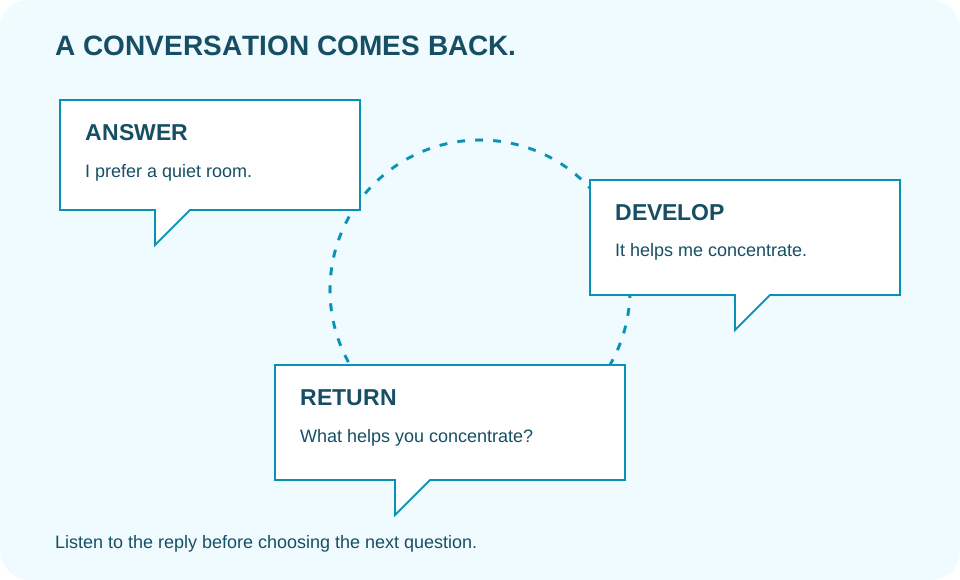
Use three moves: answer, develop, return. Answer the question directly. Develop the answer with one detail. Return the conversation to your partner with a related question.
For example:
A: “Where do you like studying?”
B: “I prefer a quiet room because I get distracted by conversation. Before an exam, though, I like discussing questions with a friend. What helps you concentrate?”
This is an invented practice exchange. Notice that B does not give a long speech or immediately jump to another topic. The follow-up grows from the answer.
Listen before choosing your next question
Your partner says: I prefer studying with a friend because we can compare our explanations. Which follow-up develops that answer?
Show a hint
Choose a question connected to comparing explanations, rather than switching to an unrelated topic.
Getting to know each other
- What is one thing you would like a new classmate to know about you?
- Which subject currently interests you most, and why?
- What do you enjoy doing between classes?
- What is one skill you would like to learn outside your department?
- Which type of story, film, or programme gives you something to think about?
- What does a satisfying day at university look like to you?
- What would you show a friend visiting your campus for the first time?
- Which ordinary task have you become better at recently?
- What is a small goal you would like to complete this week?
- What question do you wish people asked when meeting you?
For these topics, practise specific details. “I like many things” is difficult to respond to. “I enjoy sketching buildings” offers a direction for the next question. You can keep the answer simple while making it concrete.
University life and study habits
- What helps you understand a difficult lecture?
- How do you choose where to study?
- When is studying with friends helpful, and when is it distracting?
- How could a group assignment be organised more fairly?
- What would you include in a welcome guide for new students?
- Which part of giving a class presentation needs the most preparation?
- How do you keep track of deadlines?
- What makes feedback on an assignment useful?
- How would you explain your department to someone unfamiliar with it?
- What is one practical improvement you would suggest for student life?
Try asking for an example after the first answer: “Can you describe a time when that helped?” If the speaker has no real example, they can offer a clearly imagined one. Do not pressure someone to present an invented event as personal experience.
Bangladesh, culture, and everyday explanations
- How would you explain a Bangladeshi celebration to an international visitor?
- What should a visitor know before attending a university cultural event?
- How would you describe a local dish without assuming the listener knows its ingredients?
- Which place in Bangladesh would you like to learn more about?
- How can a student explain a local transport route clearly to a newcomer?
- What does hospitality look like in a situation you know well?
- How would you explain the meaning of a Bangla expression that does not translate neatly?
- What can students learn by listening to people from different districts?
- How could a campus event include people with different language backgrounds?
- Which everyday custom would you enjoy discussing with someone from another country?
Speak from your experience rather than claiming that everyone in Bangladesh does the same thing. “In my family …” and “At an event I attended …” are useful ways to keep an explanation accurate.
Opinions and everyday decisions
- Is it better to start a group project with a meeting or a written plan?
- Should students choose their own presentation topics?
- When are handwritten notes more useful than digital notes?
- What makes an online learning resource trustworthy?
- Should phones be put away during informal study sessions?
- What is a reasonable way to divide speaking time in a group?
- When does competition help students learn, and when might it get in the way?
- Should an English practice session correct mistakes immediately or afterwards?
- How can students give honest feedback without discouraging a beginner?
- What should matter most when choosing a new club activity?
Here, practise a reason that supports your view. “I prefer a written plan because it is my preference” repeats the position. “I prefer a written plan because absent members can still see the decisions” explains it.
Problems, possibilities, and future plans
- How would you organise a study meeting when everyone's timetable is different?
- What would you do if your presentation slides stopped working?
- How could an English club welcome someone who is nervous about speaking?
- What would you include in a ten-minute practice activity for beginners?
- How would you explain a project when you have only one minute?
- What could students do to reduce unnecessary paper use?
- How would you help a group return to its topic after a long distraction?
- What communication skill would help you in your next academic task?
- How would you practise an interview if you had no previous work experience?
- What would make you want to return to a language practice session?
These questions invite suggestions rather than a single correct answer. Explain how your idea would work and name a possible limitation. That gives your partner something meaningful to respond to.
Useful follow-up questions
Keep a few follow-ups available, but choose one that fits what you actually heard:
- “What makes that important to you?”
- “Could you give an example?”
- “Would your answer change in a different situation?”
- “What might be difficult about that?”
- “How would you begin?”
Avoid firing them one after another like an interview checklist. Respond to the answer first: “I hadn't considered the timetable problem. How would you choose a meeting time?”
Answer, develop, return
Practise both roles in this fictional conversation. Before revealing your line, respond to the previous speaker in your own words.
Show a hint
You can politely prefer a different approach while showing that you understood your partner.
- A
- BI would start with a short meeting because we can ask questions immediately. What would you choose?
- A
- BPerhaps we could share three questions before the meeting. Then everyone could prepare an idea.
- A
- BSome people might not read the questions, so we should explain them briefly at the start too.
A short practice session
Choose one familiar question and one opinion question. Give each person time to answer, then ask at least one follow-up. Switch who starts so one person does not always lead.
At the end, each listener summarises one idea from their partner. If the summary is wrong, the speaker explains again using different words. This checks understanding without turning every sentence into a grammar test.
Keep correction focused. Agree to discuss one useful language improvement after the exchange, especially if frequent interruption makes it difficult to continue.
Self-check: did you have an exchange?
Ask whether both people spoke, whether a follow-up referred to something actually said, and whether each person can recall the other's main idea. These checks matter more than completing a certain number of topics.
For example, after question 14, “Group work is difficult” needs more development. “It is difficult when tasks are not assigned clearly, so I would write down who is doing each part” gives the listener a problem and a proposal.
Use the 30-day practice plan to turn these questions into a routine. When you want language for agreeing, questioning, and clarifying, open the 50 useful presentation and discussion phrases.
Build an exchange from one question
Choose any topic from the list. Write an answer, one supporting detail and a related question. Then imagine a possible reply, clearly labelling it as hypothetical.
Show a hint
You may skip personal topics. Choose a subject you can discuss comfortably.
This is not an automatic grammar checker. Use the checklist below to review your writing.
- Did I answer the question before adding detail?
- Does the detail explain my answer rather than simply repeat it?
- Does my follow-up connect to what has been said?
- Have I left room for my partner to disagree or choose not to answer?
- After speaking with a real partner, can I summarise their actual idea?