
50 Useful English Phrases for Presentations and Discussions
Use 50 English phrases to explain ideas, disagree politely, handle questions, and finish presentations with a clear next step.
YOUR READING GOAL
What you will take away
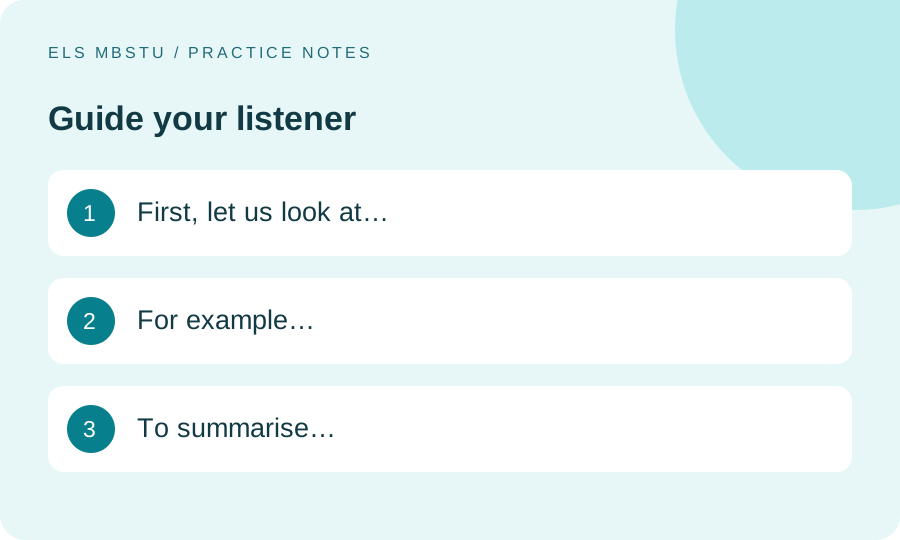
- Practise: first, let us look at…
- Practise: for example…
- Practise: to summarise…
Imagine that you understand your topic but lose time deciding how to move to the next point. You need language for the transition, not another fact about the subject.
The phrases below help you open a talk, explain a point, invite a response, and handle uncertainty. Choose a few that fit your task. Using all 50 would make most presentations sound repetitive and over-rehearsed.
The brackets show where your own information belongs. A phrase provides a structure; you still need a clear idea to put inside it.
Opening and giving direction
- “Today, I'd like to explain [topic].”
- “The question we are looking at is [question].”
- “By the end, you should have a clearer idea of [outcome].”
- “I'll begin with [first point], then move to [second point].”
- “Before we start, consider [situation].”
For example: “Today, I'd like to explain our group's waste-sorting proposal. I'll begin with the problem, then move to our suggested process.” This tells the audience what to listen for. You do not need to announce a complicated agenda for a one-minute contribution.
Moving between ideas
- “Let's start with [point].”
- “Now let's look at [next point].”
- “This leads to another question: [question].”
- “Before moving on, I'd like to clarify [detail].”
- “With that in mind, let's consider [next idea].”
Transitions should match the relationship between ideas. Use “This leads to …” when the next point follows from the first. If you are changing subjects, say so clearly rather than suggesting a connection that does not exist.
Explaining and illustrating
- “What I mean is [simpler explanation].”
- “In this context, [term] means [definition].”
- “For example, imagine [hypothetical situation].”
- “A specific example is [verified example].”
- “The important distinction is between [A] and [B].”
Keep “imagine” when the example is invented. If you introduce an example as a real result from your project, make sure that it actually happened. An effective explanation does not need a fabricated statistic or a borrowed personal story.
Referring to evidence and visuals
- “This chart compares [A] with [B].”
- “The figures shown here come from [source].”
- “Notice the difference between [items].”
- “These results suggest [careful interpretation].”
- “One limitation of this information is [limitation].”
“Suggest” is useful when evidence supports a possibility without proving every part of your explanation. Describe what a chart actually measures. Do not call a small convenience sample representative of all university students unless you have a sound basis for that claim.
Expressing and qualifying an opinion
- “In my view, [position].”
- “One reason for this is [reason].”
- “This may work well when [condition].”
- “I would be cautious about [proposal] because [reason].”
- “My view would change if [relevant condition].”
You can speak confidently while identifying limits. “This may work well for a small group” is more precise than “This will work for everyone.” Choose the strength of the statement to match your evidence.
Agreeing and disagreeing
- “I agree with your point about [specific idea].”
- “That makes sense, particularly when [condition].”
- “I agree with [part], but I'm less convinced by [part].”
- “I see the reasoning, though I would approach it differently.”
- “Could we also consider [alternative]?”
Name the idea you are responding to. “You are wrong” attacks the person and leaves the reasoning unclear. “I'm less convinced that an online meeting solves the timetable problem” identifies something the group can examine.
Inviting others and managing a discussion
- “What do you think about [idea]?”
- “Would anyone like to offer a different view?”
- “We haven't heard from everyone yet.”
- “Could we return to the question of [topic]?”
- “Let's identify what we have agreed on so far.”
Invite participation without forcing someone to speak publicly before they are ready. In a practice group, you can offer time to think or let people contribute after another speaker. A useful discussion balances listening with speaking.
Checking meaning and handling questions
- “Could you clarify what you mean by [term]?”
- “Are you asking about [interpretation]?”
- “If I understand correctly, your question is [summary].”
- “The short answer is [answer].”
- “There are two parts to that question.”
Use a clarification when it helps, not as an automatic delay before every answer. Once you understand the question, respond directly. If there are two parts, answer both or explain which part you can address.
Acknowledging uncertainty and recovering
- “I don't have that figure with me.”
- “I would need to check [source or detail] before answering.”
- “What I can say from our work is [supported point].”
- “Let me correct that: [correction].”
- “Returning to the main point, [message].”
Do not promise to send information later unless you can follow through. Correcting a number or word clearly is better than continuing with something you know is inaccurate. A brief repair usually keeps the discussion moving.
Closing and agreeing on a next step
- “The main point I would like you to remember is [message].”
- “Our recommendation is [action].”
- “The next step is to [task].”
- “Before we finish, let's confirm [decision].”
- “Thank you for listening. What questions do you have?”
For a group discussion, identify who will do the next task and when, if the group has agreed. For a presentation, end with the message rather than adding a completely new argument in the final sentence.
Exercise: choose a phrase for the job
Select a phrase and complete it for each situation:
- You want to explain an unfamiliar technical term.
- You agree with one part of a suggestion but question another.
- You are asked for a figure you have not checked.
- The group is discussing something unrelated to its task.
- You want the audience to remember your recommendation.
Possible choices are 12, 28, 41 or 42, 34, and 46 or 47. Other phrases can work if they perform the same function. The test is whether the sentence fits the situation and includes meaningful information.
Now prepare a one-minute explanation using an opening, an example, and a closing. Record it once. Remove any phrase that sounds ceremonial without helping the listener. For the complete process, use the university presentation guide; for practice questions, use the conversation topic collection.