
How to Manage Nervousness Before an English Presentation
Prepare for presentation nerves with a familiar opening, useful notes, recovery practice, a question strategy, and a contingency card.
READ · TRY · CHECK · REPEAT
What you will practise
- Turn a specific presentation worry into a practical preparation task.
- Practise asking for clarification without inventing an answer.
- Prepare a cue card and review an aloud rehearsal fairly.
This records completed tasks, not a fluency score. Your writing and progress stay in this browser; they are not synced to an account or submitted to a server.
Imagine that your slides are ready, but you keep thinking about the first minute. What if a word disappears? What if someone asks a question you cannot answer? You spend more time imagining mistakes than rehearsing your explanation.
Give yourself a plan for the parts you can control: a clear opening, an outline you can follow, a rehearsed recovery line, and a practical check of the room or equipment. You do not have to feel completely calm before you can deliver a useful presentation.
The suggestions here concern presentation preparation and ordinary performance nerves. They are not a diagnosis or a treatment programme, and no rehearsal routine can guarantee how you will feel.
Replace a vague worry with a preparation task
Write down the particular moment you are worried about. “The presentation will be terrible” is difficult to act on. “I might forget how to move from the problem to the solution” gives you something to rehearse.
Match the worry to an action:
- Forgetting the opening: practise the first two sentences aloud.
- Losing your place: put a short outline on a cue card.
- Running over time: time a full rehearsal and remove repeated material.
- Facing an unclear question: practise asking for clarification.
- Equipment trouble: prepare a version you can explain without the slides.
This exercise does not require you to argue yourself out of every concern. It turns one concern into a decision you can make.
Choose a task you can practise
You are concerned that you may lose your place between the problem and solution sections. Which preparation directly addresses that moment?
Show a hint
Choose an observable rehearsal action, not a promise about how you will feel.
Make the opening familiar
Choose an opening that you can say comfortably. For example:
“Good morning. Our group looked at how to make project meetings easier to organise. I'll explain the problem we chose, our suggested approach, and one limitation.”
This is an invented model. Replace the topic and details with your actual work. Say the opening several times, then continue into the first point so the first sentence does not become a separate performance.
Avoid changing the opening repeatedly at the last minute unless it is inaccurate. Familiar wording gives you a stable starting place.
Rehearse the task, not just the script
Reading silently can help you check wording, but it does not show how the presentation will sound. Speak aloud, move between your points, and use the notes or slides you expect to use on the day.
Try one rehearsal under conditions reasonably close to the real task. If you will stand, practise standing. If you will share a screen, practise finding the correct window. If another student speaks before you, rehearse the handover.
The aim is to discover practical problems early. You might notice that a slide contains text too small to read, that a technical term needs explanation, or that you do not know who introduces the next speaker.
Prepare a recovery route
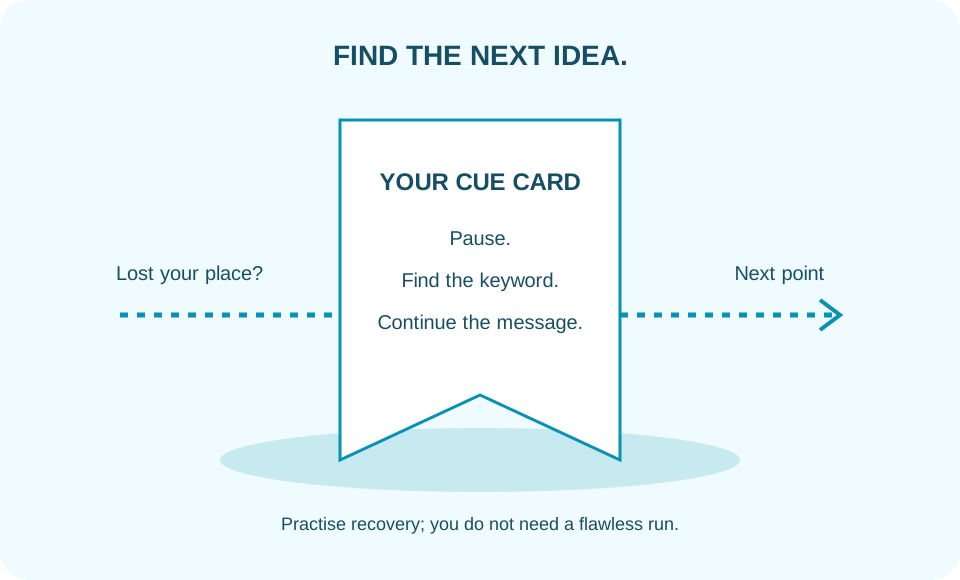
If you lose a word, describe the meaning in simpler language. If you lose your place, pause and look at the next keyword. If you make a factual mistake, correct it clearly.
Useful lines include:
- “Let me explain that more simply.”
- “The main point here is …”
- “Let me correct that figure.”
- “Moving to our next point …”
Practise one recovery deliberately. Stop in the middle of a rehearsal, find the next idea, and continue without restarting from the beginning. You are preparing for a possible interruption rather than depending on a flawless run.
Toastmasters' public-speaking preparation guidance also recommends practising recovery and becoming familiar with the speaking space. The exercise above is a practical way to apply those ideas.
Give yourself a question strategy
Listen to the full question before composing your answer. If you are unsure what it means, ask: “Are you asking about our method or our result?”
Answer directly when you know. When you do not, be precise about the gap: “We did not measure that, so I cannot draw a conclusion from our project.” You can then explain what you did examine.
Avoid replacing uncertainty with a guess presented as fact. Acknowledging a limit is part of communicating responsibly. If you promise to check something afterwards, make a note and follow through.
Handle an unclear question
Practise both roles in this fictional question session. Try your response before revealing the example.
Show a hint
Clarify the meaning, answer what you can and name the limit. Do not turn a guess into a finding.
- A
- BCould you clarify whether you mean easier to use or more accurate?
- A
- BWe did not compare their accuracy, so I cannot draw that conclusion from our project.
- A
- BWe described how the proposed process would work. Testing its accuracy would be a separate task.
Check the practical details
Before the presentation, confirm the time allowed, where you will speak, whether questions are included, and how the equipment works. Keep a readable copy of your outline available.
For a group presentation, agree on who opens, who changes slides, and how each handover happens. A short line such as “Nadia will now explain our comparison” is easier to follow than an uncertain silence.
Avoid filling the final few minutes with a complete rewrite. Review the opening, main points, and ending. Check that you have the correct file and that any required material is ready.
During the presentation, return to the message
If you notice yourself rushing, pause at the end of the current idea. Look at the next point and continue at a pace you can manage. A pause does not have to be explained to the audience.
Focus on the immediate communication task: defining the term, describing the example, or answering the question. You cannot reliably judge every listener's reaction from one facial expression.
You can use your notes. Notes are a tool for keeping the message organised, not evidence that you should not be speaking.
Exercise: make a small contingency card
Write four lines:
- My opening sentence.
- My three main keywords.
- My recovery phrase.
- My closing message.
Rehearse once with the card. Then ask a friend to choose one interruption: a lost place, an unclear question, or a slide that will not display. Work through that moment and finish the explanation.
Write a card you can actually use
Write your opening sentence, three main keywords, one recovery phrase and your closing message. Rehearse once, then add one thing a listener understood and one change for next time.
Show a hint
Choose preparation steps you control. The purpose is to continue communicating, not to prove that you feel no nerves.
This is not an automatic grammar checker. Use the checklist below to review your writing.
- Is my opening accurate for my actual topic?
- Can I follow the three keywords without reading a full script?
- Have I practised continuing after a deliberate pause?
- Does my ending return to the main message?
- Is my review based on an observation rather than an insult about myself?
Review what happened fairly
After practice, record one thing the audience understood and one change for next time. “I paused twice” is an observation, not automatically a failure. “The listener could not identify our recommendation” is a specific issue to address.
For the card exercise, success means you can find the next point and continue. The test is not whether you felt no nervousness. A useful presentation can contain pauses, corrections, and ordinary human hesitation.
If your main difficulty is organising the message, begin with your first three-minute speech. If you need wording for transitions and questions, use the presentation phrase collection and choose only the expressions your task needs.