
Public Speaking for Beginners: Prepare Your First Three-Minute Speech
Prepare a three-minute speech with one clear message, a developed example, speaking notes, rehearsal steps, and a practical exercise.
READ · TRY · CHECK · REPEAT
What you will practise
- Choose one specific takeaway for a short speech.
- Connect a reason, example and closing action to that takeaway.
- Rehearse from cues and recover from a pause without starting again.
This records completed tasks, not a fluency score. Your writing and progress stay in this browser; they are not synced to an account or submitted to a server.
Imagine that you have agreed to give a short speech at a student gathering. Three minutes sounded manageable until you opened a blank page. You have several ideas, but you are not sure which one deserves the time.
Begin with one message. Choose a point your audience can understand, support it with a reason and an example, and finish with a clear next step. A short speech becomes easier to prepare when you stop trying to include everything you know.
This guide takes you from a topic to a rehearsed outline. The sample material is invented for practice and should not be presented as an actual ELS event or personal experience.
Define what the audience should take away
Complete this sentence: “After my speech, I want the audience to …”.
“Know about teamwork” is broad. “Try assigning clear roles before starting a group task” gives you a specific purpose. You can now decide whether each point supports that purpose.
Choose a subject you can explain honestly. A small observation from study or daily life can work well. You do not need a dramatic story, a famous quotation, or a topic that makes you sound like an expert.
Consider who will listen. A group of first-year students may need background that your project teammates already know. The speech should meet the listeners where they are.
Choose a message you can develop
You have three minutes to speak to classmates before a group assignment. Which purpose is specific enough to guide your preparation?
Show a hint
Look for something listeners could actually do after the speech.
Give the speech a simple shape
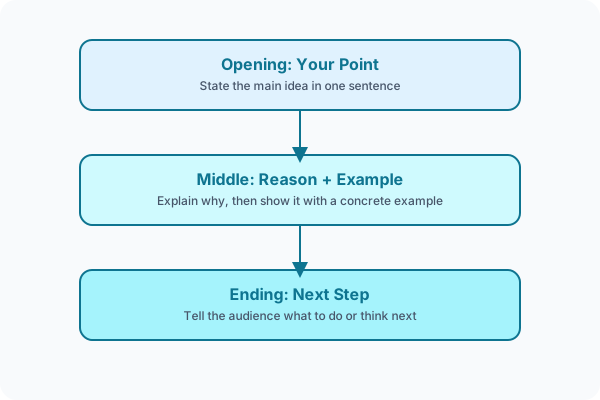
Use an opening, a developed middle, and an ending. As a rehearsal starting point, you could allow roughly half a minute to open, around two minutes to develop the message, and the remaining time to finish. Adjust after speaking aloud.
For the group-work topic, an outline might be:
- Opening: imagine a meeting where everyone assumes someone else is preparing the slides.
- Main point: agree on responsibilities before dividing up the work.
- Reason: unclear ownership makes it harder to notice missing tasks.
- Example: show how a short task list names a person and a deadline.
- Ending: suggest trying the list at the next group meeting.
The outline is a route through your idea. It should help you return to the message if you lose your place.
Open with a situation the audience can enter
Try an opening such as:
“Imagine arriving at your group meeting with the research ready, only to discover that nobody has prepared the slides. Everyone thought someone else was doing it. Before our next group project, I suggest that we make one simple change: assign each task clearly.”
The example establishes a problem and a proposal. Because it begins with “Imagine”, it does not pretend to be a real event.
You could also use a relevant question: “When your group says ‘We'll do it later’, who exactly is responsible?” Choose an opening that leads into your point. A joke unrelated to the subject creates another transition you will have to manage.
Develop one reason properly
A weak middle names several benefits without explaining them: “Roles are useful. They save time. They improve everything.” A stronger middle shows how the proposal changes a task.
For example:
“If the group writes ‘prepare slides’ without a name, the task still belongs to everyone and no one. Adding a name makes it possible to ask whether the person has what they need. Adding a deadline gives the group time to review the slides before the presentation.”
This explanation describes a possible mechanism. It does not claim that every group will succeed or that a task list solves all teamwork problems.
You can acknowledge a limit: “The list should be agreed together, so responsibilities match people's available time.” A relevant qualification can make the proposal more practical.
Use an example the audience can picture
Instead of saying “Improve coordination”, describe what people would do:
“At the end of the meeting, write three lines: what needs doing, who will do it, and when the group will check it. Read the lines aloud so everyone can correct a misunderstanding before leaving.”
Concrete actions are easier to remember than abstract praise. If you use a real example, check that you have permission to identify other people. You can describe a process without turning a classmate's mistake into a public story.
If you use a number or external claim, verify it and explain its source. For a first speech, you can often teach the idea clearly without adding a statistic at all.
End with the message you want remembered
An ending should feel connected to the opening:
“A group project needs shared effort, but it also needs clear responsibility. At your next meeting, spend a moment agreeing on the task, the person, and the deadline. That small conversation can make the next step easier to see.”
Avoid adding a new major point in the final sentence. If your speech has been about task ownership, do not suddenly end with advice about presentation design.
“Thank you” can follow your conclusion, but it does not replace one. The audience should understand what you want them to take away before you thank them.
Finish the speech you started
Your speech explains why group tasks need a named owner and deadline. Which ending completes that message?
Show a hint
The ending should recall the main point and give a practical next step, without adding a new major subject.
Turn the draft into speaking notes
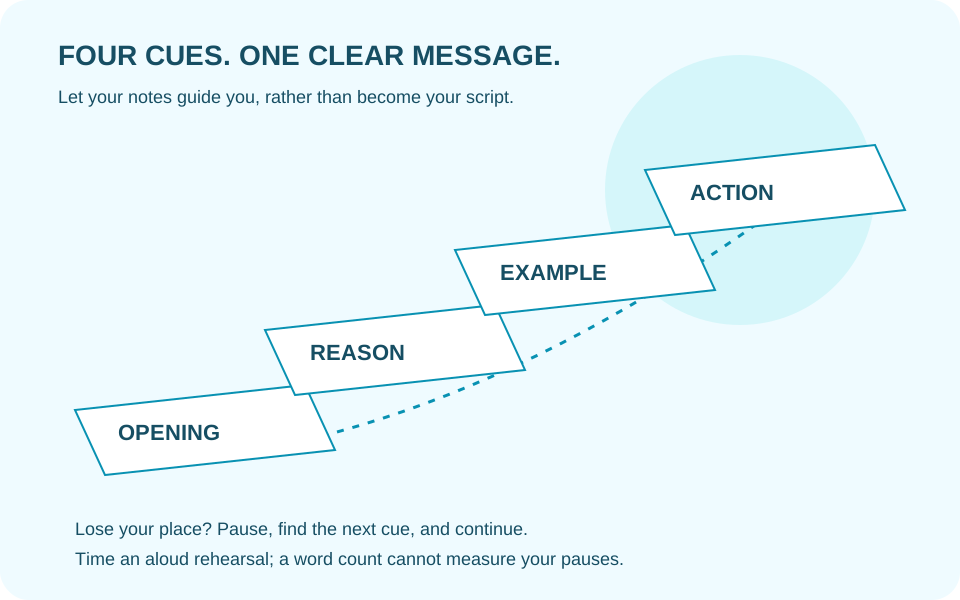
You may write a full first draft to organise your thoughts. Then reduce it to a small set of cues, such as “missing slides — responsibility — name and deadline — next meeting”.
Rehearse from those cues. If you repeatedly lose an important detail, add a brief prompt. Your notes should support your delivery, not force you to search through a dense paragraph while speaking.
Use language you can say comfortably. Read a sentence aloud; if you run out of breath or lose the meaning halfway through, divide it. Written complexity does not automatically improve a spoken message.
Time the speech at your actual pace
Deliver the speech aloud and use a timer. If it is too long, remove a repeated explanation or a less relevant example. Speaking faster may fit the clock while making the message harder to follow.
If it is too short, check what is missing. Does the audience understand why the point matters? Have you illustrated the idea? Add necessary explanation rather than filling time with greetings or repeated conclusions.
Exact timing depends on your pace and pauses. Treat a word-count estimate as a rough planning aid, not a substitute for rehearsal.
Practise continuing after a mistake
Deliberately pause halfway through one rehearsal. Look at your next keyword and continue: “The practical step is …” or “Returning to the main point …”.
If you use the wrong word, repair it briefly: “I mean the deadline, not the meeting time.” You do not need to apologise for every small slip.
Toastmasters' preparation guidance includes rehearsing aloud and practising recovery. Use those as preparation tasks, not as a promise that all nervousness will disappear.
Rehearse recovering from a pause
Speaker A is a practice partner; Speaker B is rehearsing. Say B's line in your own words before opening the example. Then swap roles. The partner's questions belong to rehearsal, not necessarily to a real speech.
Show a hint
Use the next keyword to return to the message. You can repair a word briefly without restarting the whole speech.
- A
- BThe practical step is to agree on who owns each task.
- A
- BFor example, write: comparison chart, Rafi, Thursday afternoon. These are fictional practice details.
- A
- BI mean the deadline for sharing the chart, not the meeting time. The group needs time to review it.
Your drafting exercise
Choose one of these messages:
- Ask a follow-up question before changing the conversation topic.
- Give a group member specific feedback rather than saying only “good”.
- Keep one clear record of a group's final decisions.
Write an opening, one reason, one example, and a closing action. Rehearse the outline, then ask a listener to summarise your message in one sentence.
There is no single model answer. A successful response has a recognisable point, a supporting explanation, and a next step the audience could actually try. If the listener remembers only the opening story, strengthen the connection between the story and your message.
For preparation when nerves are taking your attention, read how to manage nervousness before a presentation. When slides and questions become part of the task, use the university presentation guide.
Build your own speech route
Write four labelled parts: opening, reason, example and closing action. Choose one of the messages in the drafting exercise or a genuine topic of your own. Below them, write four short cue phrases and the time of one aloud rehearsal.
Show a hint
Your opening should lead into the same message that your ending reinforces. Treat the model as an invented example, not as your own experience.
This is not an automatic grammar checker. Use the checklist below to review your writing.
- Can I state the audience's takeaway in one sentence?
- Does my reason explain why the proposal could help, without promising it always works?
- Is my example genuine, or clearly identified as hypothetical?
- Does the ending ask for a realistic action related to the opening?
- Have I rehearsed aloud at a comfortable pace and noted what to shorten or explain?