
English Pronunciation for Bangla Speakers: A Practical Starting Guide
Practise English word stress, sound contrasts, endings, and clear phrasing with a focused pronunciation guide for Bangla speakers.
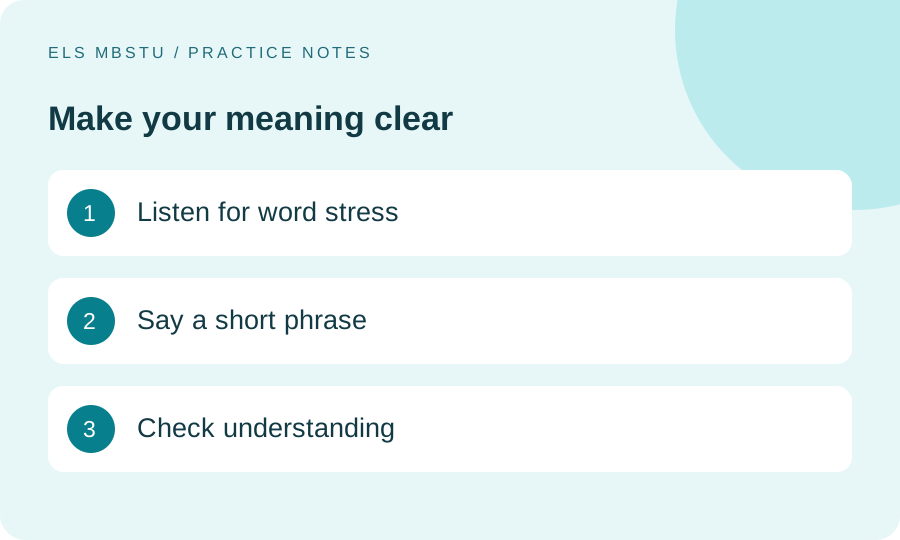
YOUR READING GOAL
What you will take away
- Practise: listen for word stress
- Practise: say a short phrase
- Practise: check understanding
Imagine that you explain an idea clearly, but your listener asks you to repeat one word. You say it louder. They still look uncertain. The problem may be the sounds, the stressed syllable, or the way the word fits into the sentence.
Start with the word or sentence that caused the misunderstanding. Listen to a reliable model, notice one feature, and practise it in a meaningful phrase. You do not need to change your entire accent before you can communicate well.
Bangla-speaking learners have different language backgrounds and pronunciation patterns. Use the checks below to find your own priorities rather than assuming that every item will be difficult for you.
Work towards understanding
Your first question is “Could the listener understand my meaning?” A pronunciation difference is not automatically a communication problem. Focus on differences that repeatedly make your words difficult to identify.
Ask a partner to write down what they heard in a short sentence. If their version matches your meaning, the message worked. If it does not, identify the particular word or phrase and work on that part.
Use a learner's dictionary with audio to check unfamiliar words. Listen before trying to represent the sound in Bangla letters. A Bangla spelling approximation can miss distinctions that the audio preserves.
Notice the stressed syllable
A syllable is a beat within a word. In words with several syllables, one usually receives the main stress: it stands out from the others. The British Council's word-stress explanation describes stress as prominence involving features such as length, loudness, and pitch.
Try these teaching spellings, where capitals show the stressed part:
- STU-dent
- dis-CUSS
- pre-sen-TA-tion
- uni-VER-si-ty
The divisions are a practice aid, not a replacement for dictionary pronunciation. Listen to each word, tap the prominent beat, and use it in a sentence: “We need to dis-CUSS the plan.”
Do not give every syllable equal force. Make the stressed part noticeable without shouting. Also avoid assuming that related words keep the same stress; check the word you actually intend to use.
Compare sounds when you confuse them
One useful practice pair is vest and west. For the usual English /v/ sound, the upper teeth approach or touch the lower lip while air continues through; you should feel voicing. For /w/, the lips round and then move into the following vowel without that teeth-to-lip contact.
Try “vest — west” slowly, then in phrases: “a green vest” and “the west side”. Ask a listener which word they heard without showing them your choice.
If you already distinguish these comfortably, move on. A practice guide should help you diagnose a need, not persuade you that you have a problem you do not have.
For a different sound contrast, choose words you personally confuse and check their dictionary audio. Avoid trying to learn several new mouth positions in one session.
Give word endings enough attention
An ending can carry important information. Compare “book” with “books”, or “plan” with “planned”. If the ending disappears, your listener may miss a plural or a past-time signal.
Practise the whole phrase, such as “two books” or “we planned it”. Do not add an extra full vowel just to make an ending louder. Listen to the model and aim to keep the ending connected to the word.
Be careful with written -ed: it does not have the same pronunciation in every word. For example, the endings in “worked”, “played”, and “wanted” differ. Check each model rather than reading the spelling as a separate syllable every time.
Bangla support: বানান দেখে প্রতিটি অক্ষরকে আলাদা শব্দধ্বনি ধরে নেবেন না। আগে শুনুন, তারপর শব্দটি ছোট বাক্যে বলুন। বিশেষ করে শব্দের শেষ অংশ বাদ যাচ্ছে কি না খেয়াল করুন।
Put important words into clear groups
Long sentences become harder to follow when you rush through them without meaningful pauses. Divide a sentence into idea groups:
“Our group compared two options / and chose the simpler one / because we had limited time.”
The slashes suggest possible pauses, not compulsory punctuation. Say each group as a connected unit. Then try the full sentence at a comfortable pace.
Stress can also change what you contrast. “We need the BLUE folder” distinguishes it from another colour. “We need TWO folders” highlights the number. Decide which information your listener needs to notice.
You do not have to exaggerate every content word. Start with one contrast and check whether your partner hears it.
Use recordings for a specific question
Choose one sentence and record it. Before listening, decide what you are checking: a word ending, a stressed syllable, or a pause. This keeps the review manageable.
Listen to the reference audio again, then make another attempt. Compare the chosen feature rather than judging whether you sound like the speaker in every way.
Automatic captions can provide a clue, but they are not a pronunciation examiner. They may misrecognise names, accents, background noise, or technical vocabulary. Use a human listener and reliable audio where possible before deciding a word is wrong.
Exercise: a short pronunciation check
Try these tasks with a partner:
- Say “student”, “discuss”, and “presentation”. Ask which part sounds strongest.
- Choose “vest” or “west” without showing your partner. Say it in a short phrase and ask them to identify it.
- Say “one book” and “two books”. Check whether the ending is audible.
- Say “I asked for the blue folder, not the green one.” Make the colour contrast clear.
Work on only one uncertain item, then repeat the relevant task. The goal is a clearer distinction, not a perfect performance of the entire list.
Answers and self-check
For the stress exercise, the target patterns are STU-dent, dis-CUSS, and pre-sen-TA-tion. For the other tasks, the answer is whether the listener identifies the intended word, number, or contrast without seeing your script.
If they cannot, listen to a model and try the phrase more slowly. If you are unsure about how to produce a sound, ask a teacher for feedback rather than repeatedly practising a guess.
Continue with a real speaking task from the conversation topic collection. Pronunciation practice is most useful when you bring the clearer word back into something you want to say.