
A 30-Day English Speaking Practice Plan for University Students
Follow 30 manageable speaking tasks for university life, with weekly reviews, conversation practice, and a final progress check.
YOUR READING GOAL
What you will take away
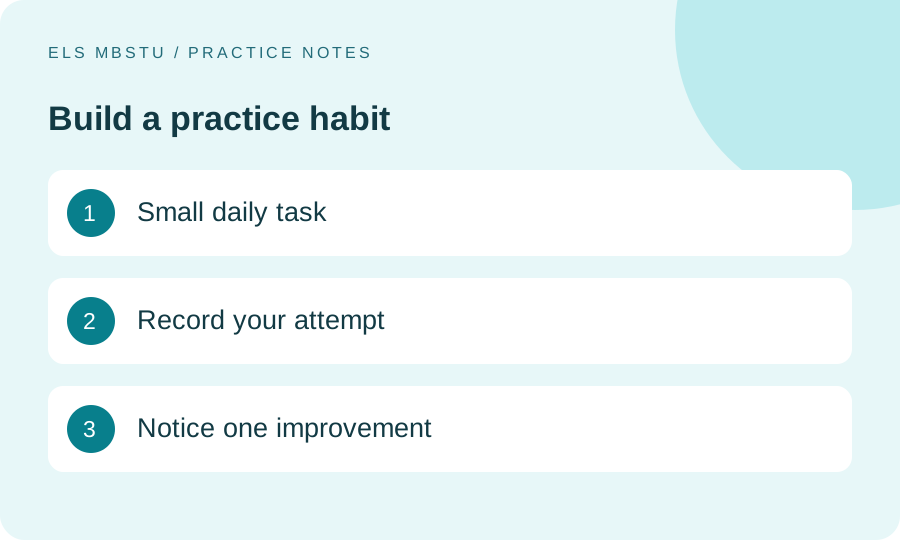
- Practise: small daily task
- Practise: record your attempt
- Practise: notice one improvement
Imagine finishing another week with several saved English videos and very little speaking practice. You intended to start, but choosing an activity became a task of its own.
This plan gives you one spoken task for each of 30 practice days. Keep a notebook and, if available, a phone recorder. Most tasks can fit into around 10–15 minutes, but adapt the time to your schedule. Thirty days is a practice sequence, not a promise of fluency.
If you miss a day, continue from the next unfinished task. You do not have to restart the month or rush through several activities to catch up.
Use the same simple routine
For each day, prepare a few keywords, speak aloud, review one aspect, and try again. Recordings are optional; a partner can also tell you what they understood.
Keep a three-line log:
- Task: what I tried to communicate.
- Observation: one thing that was clear or confusing.
- Next attempt: one specific change.
For example: “Explained my route to class. I forgot to name the starting point. Next time, begin with ‘From the main gate …’.” This observation is more useful than rating yourself as simply good or bad.
Use the printable speaking log and feedback sheet to record one useful change after each attempt.
Days 1–7: talk about familiar things
Day 1 — Make a starting recording. Answer “What are you studying, and what interests you about it?” Keep this first attempt. Do not edit it into a performance.
Day 2 — Introduce yourself. Give your name, relevant study information, and one genuine interest. Use the self-introduction guide if you need a structure.
Day 3 — Describe a routine. Explain what you usually do before your first class. Put the actions in an order someone else can follow.
Day 4 — Describe yesterday. Choose three completed actions. Notice the change from present routines to past events: “I usually walk” becomes “Yesterday I walked.”
Day 5 — Explain a route. Give directions between two familiar places. Ask a partner whether they can identify the starting point and destination.
Day 6 — Describe an object without naming it. Explain what it does, where you use it, and one feature. Let someone guess, or check whether your description is specific enough.
Day 7 — Review the first week. Repeat the Day 1 prompt. Identify one difference and one remaining difficulty. Keep both recordings without deleting the earlier attempt.
Days 8–14: build a conversation
Day 8 — Add a reason. Give an opinion about a study habit. Add “because” and a reason that genuinely explains your preference.
Day 9 — Add an example. Revisit yesterday's opinion and illustrate it with a real experience or a clearly labelled hypothetical situation.
Day 10 — Ask follow-up questions. Prepare questions beginning with “Why …?”, “How …?”, and “What happened next?” Use them in a short conversation.
Day 11 — Check understanding. Practise “Do you mean …?” and “Could you explain that part?” Your task is to understand accurately, not to pretend that everything is clear.
Day 12 — Make a suggestion. Propose a time or place for a study meeting. Give a reason and invite the other person's response.
Day 13 — Disagree politely. Choose a harmless preference, such as studying early or late. Acknowledge your partner's point, then explain your different view.
Day 14 — Hold a short exchange. Combine an opinion, a follow-up question, and a response. If alone, record an imagined dialogue and label it as practice.
Days 15–21: explain ideas clearly
Day 15 — Define a familiar term. Choose something from your course. Explain it to someone outside your department without assuming they know the specialist vocabulary.
Day 16 — Describe a process. Explain how to complete a simple task. Use “first”, “next”, and “finally” only where the sequence needs them.
Day 17 — Compare two options. Compare two study methods using the same criteria, such as time, concentration, or access to resources.
Day 18 — Summarise a short text. Read a paragraph, close it, and explain its main idea in your own words. Reopen it afterwards to check that you preserved the meaning.
Day 19 — Explain a problem and solution. Name one campus problem, describe its effect, and propose a realistic response. Avoid claiming a solution will work for everyone.
Day 20 — Respond to an unexpected question. Ask a partner to choose a follow-up about yesterday's explanation. Take a moment to think before answering.
Day 21 — Review clarity. Repeat Day 15's definition for a new listener if possible. Ask which word or step still needs explanation.
Days 22–28: speak to an audience
Day 22 — Choose one message. Plan a short speech with a single point. Complete: “After listening, I want people to understand …”.
Day 23 — Build the middle. Add a reason and an example that support your message. Remove details that lead to a different topic.
Day 24 — Write an opening and ending. Open with a relevant question or concrete situation. End by returning to your main point and giving a useful next step.
Day 25 — Rehearse aloud. Time your speech at a comfortable pace. Shorten the content if it runs over; do not solve the problem by racing.
Day 26 — Practise recovery. Deliberately stop in the middle. Find your next keyword and continue with “The main point here is …”.
Day 27 — Answer a question. Invite one question after your speech. Answer what you know and identify what you would need to check.
Day 28 — Give and receive feedback. Ask for one clear strength and one specific improvement. If practising with a friend, offer the same kind of feedback on their speech.
Days 29–30: compare and choose the next goal
Day 29 — Return to the starting prompt. Answer the exact Day 1 question again. Listen to the first and latest attempts for organisation, useful detail, and your ability to continue after a pause.
Day 30 — Try a new task. Explain an unfamiliar but manageable topic, such as a new course assignment. Choose the skill that still needs the most work and plan the next week around it.
Repeating the same prompt shows what changed on a familiar task. Trying a new one helps you notice whether you can adapt your language beyond a practised answer.
Adjust the plan to your starting point
If a full answer feels difficult, begin with two complete sentences. If the task is easy, add a comparison, a reason, or a follow-up question. Increasing difficulty does not have to mean using rarer vocabulary.
For listening input, choose a short lesson from the British Council's speaking collection. Select a manageable level and use one expression in your own task. Watching the lesson is preparation; speaking your own response completes the activity.
You can reuse a topic across several days. A project can supply a description, a process, a problem, and a short presentation. Keeping the subject familiar leaves more attention available for the communication skill.
Avoid turning practice into copying
A model answer can show you a structure, but copying a full paragraph hides the choices you need to practise. Change the facts, ask a new question, and try another version without reading.
For example, after practising “I prefer studying in the morning because …”, explain an occasion when evening study was more practical. You now have to choose language that fits a different meaning.
Keep examples truthful when discussing your own life. If you invent a scenario to practise, introduce it with “Imagine …”. The goal is language practice, not building a fictional personal history.
Your end-of-plan self-check
Choose one recording and answer these questions:
- Can a listener state my main point?
- Have I included a relevant reason or example?
- Can I explain an unfamiliar word using simpler language?
- Can I ask for clarification?
- Can I continue after a mistake without starting everything again?
These are personal checks, not a proficiency examination. A “not yet” answer gives you the next task. If your main point is clear but your examples are vague, spend the next week adding concrete detail.
For more practice subjects, use the 50 conversation topics. If the audience stage is your priority, continue with your first three-minute speech. Keep the record of what you actually did: it will help you choose useful practice after these 30 days.