
Common English Mistakes Bangla Speakers Make—and How to Correct Them
Practise ten English grammar and usage patterns with Bangla support, corrected examples, and an exercise with explained answers.
YOUR READING GOAL
What you will take away
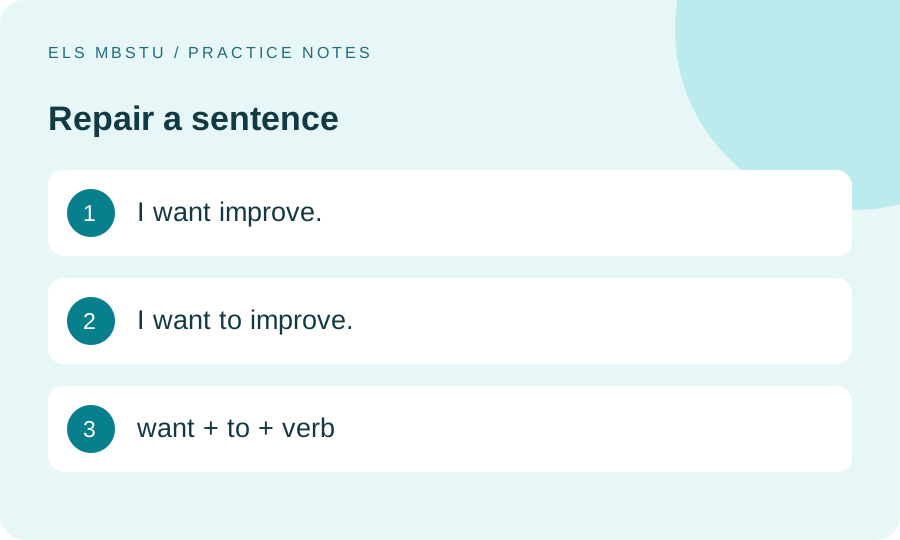
- Practise: i want improve.
- Practise: i want to improve.
- Practise: want + to + verb
Imagine that you finish a useful answer in class and then remember one sentence: “Yesterday I go to the library.” The mistake is real, but it does not mean the whole answer was worthless. You can correct the pattern and use it again.
This guide covers ten useful patterns to check in standard English. They are practice examples for Bangla-speaking learners, not a claim that every Bangla speaker makes the same errors or that these are statistically the most frequent mistakes.
Read the explanation, change the example to fit your life, and say your new sentence aloud. Learning a correction is more useful when you can reuse it.
1. Introduce yourself with a complete sentence
Needs correction: “Myself Rafi.”
Use: “I'm Rafi” or “My name is Rafi.”
Myself does not replace I am in this introduction. It works in a sentence such as “I introduced myself to the class.” Keep the short introduction ready for a real conversation.
2. Use the verb agree directly
Needs correction: “I am agree with you.”
Use: “I agree with you.”
Agree is already the main verb here. You can say “I am happy with the decision,” because happy describes your state, but the pattern is different.
Practise the contrast: “I agree with the suggestion.” “I am unsure about the suggestion.” Do not assume that every sentence about your opinion needs am.
3. Match a present-tense verb to its subject
Needs correction: “She study every evening.”
Use: “She studies every evening.”
Compare “I study”, “we study”, and “she studies”. In a negative sentence with does, use the base form: “She does not study here,” not “She does not studies here.”
Cambridge's subject–verb agreement reference explains how the subject determines the verb form. Start with straightforward examples before moving to more complicated group nouns and exceptions.
4. Keep completed past events in the past
Needs correction: “Yesterday we discuss the assignment.”
Use: “Yesterday we discussed the assignment.”
Some past forms are irregular: “go” becomes “went” and “write” becomes “wrote”. Learn them through sentences you need, rather than treating every verb as if adding -ed will work.
বাংলায় সময় বোঝা গেলেও ইংরেজি বাক্যে ক্রিয়ার রূপটি আলাদা করে দেখতে হবে। “Yesterday” লিখে বাকির সব ক্রিয়া বর্তমান কালে রাখবেন না।
5. Put the helper before the subject in a direct question
Needs correction: “Where you live?”
Use: “Where do you live?”
For a past event, use “Where did you go?” The main verb remains go after did. “Where did you went?” uses the past marking twice.
Practise: “What do you study?” “When did the class finish?” These are direct questions; other sentence types can use a different order.
6. Say what you discussed without adding about
Needs correction: “We discussed about the problem.”
Use: “We discussed the problem.”
You can also say “We talked about the problem.” The two verbs use different patterns. Learn the whole expression so you do not transfer a preposition automatically from one verb to another.
7. Use to before the person receiving an explanation
Needs correction: “Please explain me the rule.”
Use: “Please explain the rule to me.”
You can also say “Please explain it to me.” Compare this with “Please tell me the answer.” Explain and tell do not use exactly the same structure.
8. Separate a starting point from a duration
Needs correction: “I have studied here since two years.”
Use: “I have studied here for two years.”
Use for with a duration, such as two years. Use since with a starting point, such as September: “I have studied here since September.” Cambridge's guide to since gives further examples of the starting-point meaning.
বাংলায় “দুই বছর ধরে” এবং “সেপ্টেম্বর থেকে”—এই পার্থক্যটি খেয়াল করলে এখানে for ও since বেছে নেওয়া সহজ হয়।
9. Treat advice as uncountable in this use
Needs correction: “She gave me two advices.”
Use: “She gave me two pieces of advice.”
For an unspecified amount, use “some advice”. Similarly, “information” normally stays uncountable in ordinary learner examples: “some information”, not “an information”.
Do not assume every English noun behaves like the closest Bangla expression. Check a learner's dictionary when you are unsure how a noun is counted.
10. Use a plural group after one of
Needs correction: “One of my friend is absent.”
Use: “One of my friends is absent.”
You are selecting one person from a group of friends, so friends is plural. The subject of the main clause is one, which takes is in this sentence.
A useful practice pair is “My friends are here” and “One of my friends is here.” Notice which part changes and why.
Practise without trying to repair everything at once
Choose two patterns that appear in your own writing or speech. Write one true sentence for each, then use those sentences in a short spoken answer. The next day, change the details and repeat.
Avoid labelling a correct alternative as wrong simply because it differs from your model. English often offers several natural ways to express the same idea. The corrections here address the specific structures shown.
Exercise
Correct these sentences:
- “I am agree with this idea.”
- “Where did she went?”
- “We discussed about our timetable.”
- “He has lived here since three months.”
- “One of my classmate needs help.”
Answers and reasons
- “I agree with this idea.” Agree does not need am here.
- “Where did she go?” Use the base verb after did.
- “We discussed our timetable.” Discuss takes the topic directly.
- “He has lived here for three months.” Three months is a duration.
- “One of my classmates needs help.” Select one from the plural group; one takes needs.
Now use two corrected patterns in a conversation about your studies. If introductions are your immediate task, continue with how to introduce yourself in English. Accuracy becomes more useful when you can bring it into a message of your own.