
How to Improve Spoken English in Bangladesh: A Practical Student Guide
Build spoken English practice around university life with a simple routine, clear examples, partner tasks, and a practical self-check.
YOUR READING GOAL
What you will take away
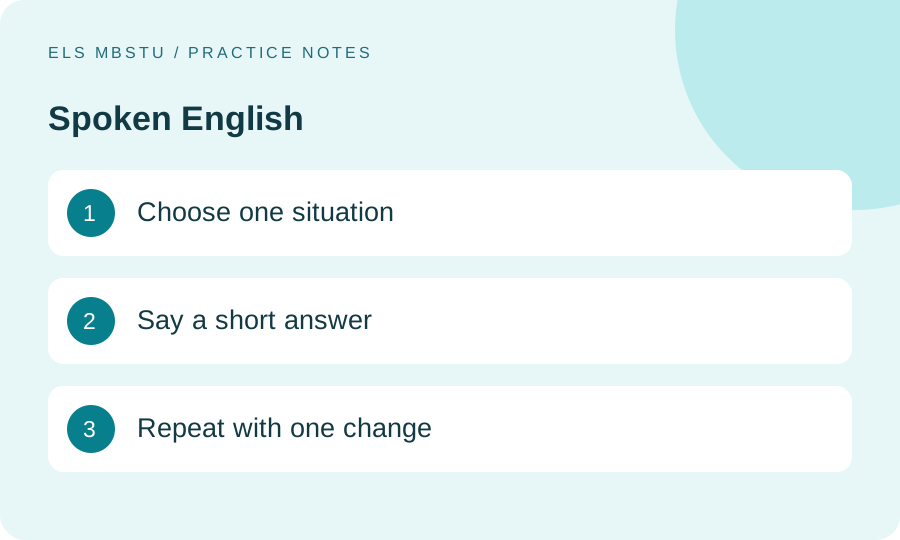
- Practise: choose one situation
- Practise: say a short answer
- Practise: repeat with one change
Imagine that you have understood an entire lecture in English. Afterwards, a classmate asks what you thought, and you struggle to put together two sentences. You know the topic. You recognise the words. Speaking still feels difficult.
Start by making your practice resemble the conversation you want to have: choose a familiar subject, say something aloud, notice one difficulty, and try again. Reading about English can support that process, but you also need opportunities to produce your own sentences.
This guide helps you build that practice around university life. You do not need an expensive setup, a particular accent, or a partner who speaks perfectly. You need a manageable task and a way to check whether your message reached someone.
Choose a situation before choosing a resource
“Improve my English” is too broad to guide today's practice. “Explain my group project to a classmate” tells you what to prepare.
Write down three situations in which you want to speak more comfortably. These might include asking a question in class, introducing yourself to a new student, or answering a viva question about an assignment. Pick the situation you expect to encounter first.
For example, suppose your next task is describing a project. Your immediate vocabulary needs are words such as purpose, method, problem, and result. A long list of rare adjectives will be less useful for that particular conversation.
Turn the situation into a small outcome: “By the end of this practice, I want to explain what our project does in four connected sentences.” The outcome gives you something observable to work towards.
Find out where your sentence stops
Record a short answer to this prompt: “What are you studying, and what interests you about it?” Speak for as long as you comfortably can, up to one minute. Do not write a script first.
Listen once for meaning. Could someone unfamiliar with your department understand your answer? Then identify the main obstacle:
- Finding an idea: you were unsure what to say, even in Bangla.
- Finding a word: you had the idea but lacked a useful expression.
- Building the sentence: you knew individual words but could not connect them.
- Being understood: the sentence was complete, but a listener struggled to follow it.
- Continuing: you stopped after one sentence and did not know how to develop it.
These problems need different responses. If ideas are the difficulty, brainstorm first. If you need an expression, find one and use it in a sentence. If a listener cannot follow, check pace, pronunciation, and organisation rather than assuming every problem is grammar.
Use a four-part practice loop
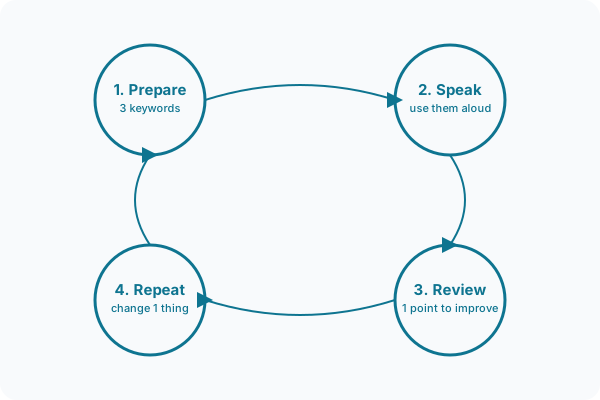
Try this sequence for one small task. The suggested times are a practical starting point, not a tested prescription.
Prepare for three minutes. Choose a topic and write three keywords. For a project explanation, your notes might be “waste — categories — collection”. Avoid drafting a paragraph that you will simply read.
Speak for two minutes. Give your answer aloud. It can be shorter than two minutes; the remaining time is for another attempt. If a word disappears, explain around it: “It is the container where we put paper separately.”
Review for three minutes. Listen to your recording or ask a partner one specific question: “Was it clear why we chose this project?” Note one change. Do not try to repair every sentence at once.
Repeat for two minutes. Answer the same question again, using the change. Then ask yourself a slightly different question so that you practise adapting, not reciting.
A useful record is: “Today I explained the project purpose more clearly.” “My English is bad” gives you nothing to practise next.
Build with phrases you can adapt
Keep a small collection of useful sentence beginnings:
- “The main purpose is to …”
- “One difficulty we faced was …”
- “For example, …”
- “I would like to understand …”
- “Could you explain what you mean by …?”
Change the details each time. “The main purpose is to reduce paper waste” can become “The main purpose is to compare two methods.” You are practising a useful pattern while still choosing your own meaning.
Bangla can help you identify that meaning. You might first note “সমস্যাটা কী” or “কেন দরকার”. Then express one idea at a time in English. You do not have to translate a long, polished Bangla sentence word for word.
For example, start with “Our group studied water use.” Add “We compared two student households.” Add “We wanted to identify where water was being wasted.” Three clear sentences can carry more meaning than one complicated sentence you cannot finish.
Make listening part of the task
Choose a short recording that you can mostly understand. Listen for an expression connected to your chosen situation. Pause, say it aloud, and make a new sentence using the pattern.
The British Council's speaking resources organise practice around everyday situations and language levels. Use one suitable lesson as input, then produce your own response rather than stopping after watching it.
For instance, after hearing someone make a suggestion, suggest a place for your group to meet. After hearing an introduction, introduce yourself with your own details. The source provides a model; your response makes the task active.
Practise with someone without turning it into an examination
Agree on roles before you begin. One person speaks; the other listens for the main message. After a minute or two, the listener summarises what they understood. Then swap.
Ask for one useful observation: “Which part needed more explanation?” This is easier to act on than “Tell me every mistake.” If both of you are uncertain about a correction, check a reliable learner's dictionary or ask a teacher instead of confidently teaching each other a guess.
A partner does not have to be more advanced to notice missing information. If you say “It was useful,” they can ask “What was useful?” That question helps you become more precise.
If a partner is unavailable, record both sides of a short imagined conversation. Leave a pause between the question and your answer. Keep this as practice, not as a claim that you have had a real conversation.
Correct mistakes after protecting the message
Consider this practice response:
“Yesterday our group discuss a problem. It very difficult. We make a plan.”
A clearer version is:
“Yesterday our group discussed a problem. It was difficult, so we made a plan.”
The main repair is consistent past time: discussed, was, and made. The word so also shows the connection between the difficulty and the response.
For today's practice, you could choose only the past-tense pattern. Tomorrow, you might explain what the problem actually was. Accuracy and detail are both useful, but separating them can make revision manageable.
Avoid replacing familiar words with impressive ones merely to sound advanced. If “help” expresses your meaning, you do not need “facilitate” in every sentence. Your listener needs to follow the idea.
Keep going when you miss a day
University routines change. Exams, travel, and group assignments can interrupt a plan. Make a smaller version of your practice for busy days: one question, one spoken answer, and one improvement.
If you miss several days, restart with a familiar topic. You do not need to compensate by forcing a long session. Keep a simple record of what you actually practised, including a note when an activity was too difficult and needed adapting.
After a week, repeat your first recording prompt. Compare the recordings for clear ideas, useful detail, and your ability to continue after a pause. Do not judge progress only by speed. Speaking faster can make a confusing explanation harder to follow.
Try it now: explain one campus problem
Choose a small problem, such as unclear meeting times or difficulty finding a study space. Complete these prompts, then speak without reading every word:
- The problem is …
- It affects students because …
- For example, …
- One possible solution is …
Here is an invented model answer:
“Our group sometimes starts meetings late because we confirm the time in several different messages. Last week, two people followed an older message. One possible solution is to keep the final time in one clearly labelled announcement.”
The example identifies a problem, explains its cause, gives an illustration, and proposes an action. Your answer can use simpler language and still do all four things.
Check your own answer
Ask a listener to name your problem and proposed solution. If they cannot, make those two sentences more explicit. If you are practising alone, listen once without looking at your notes and write the two ideas you hear.
Check whether your example supports the problem you named. Then choose one sentence to improve and record it again. There is no single correct answer because your campus situation will differ; the test is whether the explanation is clear and connected.
For a daily sequence, use the 30-day speaking practice plan. When you need a fresh subject, choose from the 50 conversation topics. Start with one task you can complete today, then make the next task slightly more demanding.